How We Work
The performance of your frontline teams is shaped by what their managers do. If your managers don’t lead differently, their teams won’t perform differently. But, there are 2 problems;
Your organization runs on systems and processes. Without them, things would quickly fall apart. But most managers don't have the right processes to follow, to help them maximize team performance.
Most managers aren't skilled in the practical techniques they need to motivate their people for high-performance.
Here’s the Performance Leadership System we customize for clients to help overcome these problems.
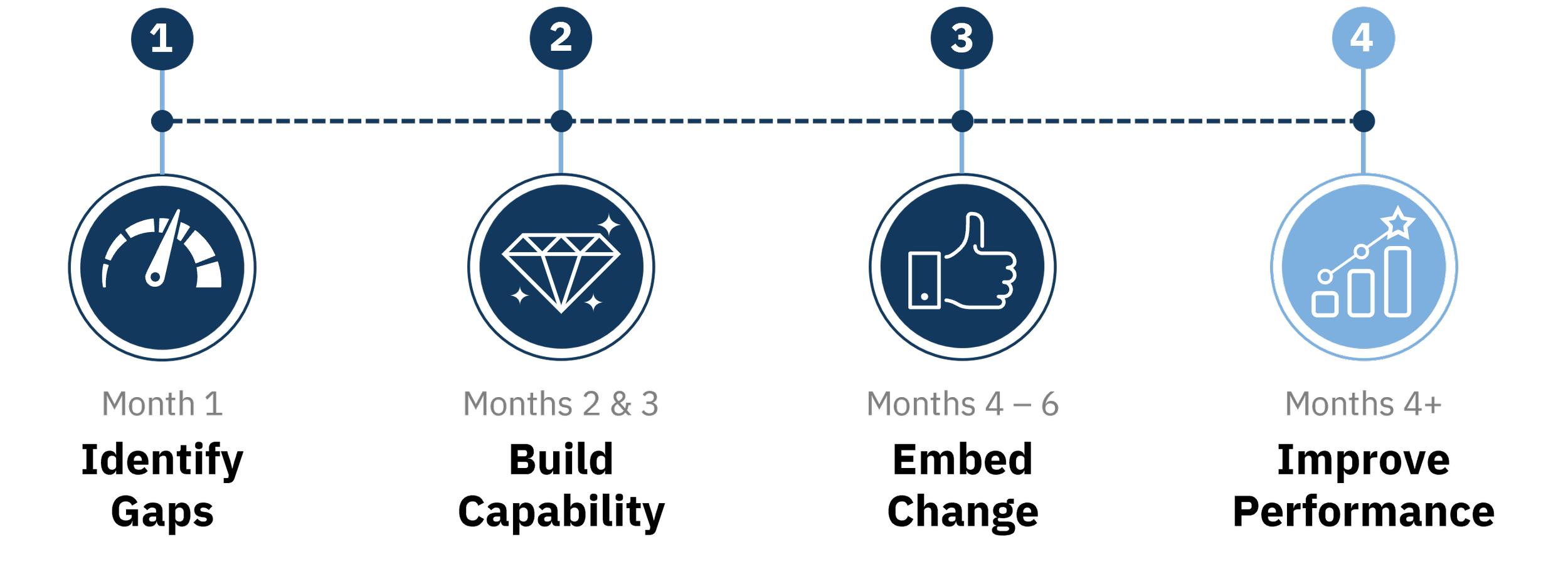
Click a phase to see more details.
-
We start by:
Identifying the performance improvement goals that can be achieved during our engagement.
Identifying the gaps in the people management processes followed by your managers, and their skills to improve performance.
Agreeing on the new people management processes to be implemented.
Agreeing how you will hold managers accountable for implementation.
-
We build the capability of your managers in the areas identified as gaps in Phase #1.
There are 8 strategies which clients have found necessary for their managers to master, to get the performance improvements they seek.
To learn more about these strategies, see ‘The 8 Strategies of Performance Leadership' section below.
-
We provide ongoing coaching and support to you as a senior leader - and your managers - to enable them to implement the strategies as business-as-usual, so you achieve your performance improvement goals.
-
You'll see improvements in performance starting in month 3, as your managers start implementing.
However, it takes until months 4 - 6 for improvements to really take off.
Building Capability: The 8 Strategies
Through working with 70+ organisations, and interviewing hundreds of managers of high-performing teams, we’ve discovered there are 8 strategies which create the biggest improvements in the performance of frontline teams.
However, your situation is unique. As a result, we help your managers customize how they implement the strategies in Phase #2: Build Capability, so they achieve the performance improvements you need. Click a strategy to see more details.
-
You have a KPI you want to improve. The problem is that there are many factors contributing to it, which are beyond the control of frontline team members. Such as the time of year, staffing, advertising, customer demand, and more. You can't hold frontline team members accountable for something they don't have full control over.
Unfortunately, what’s not often tracked are the actions taken by individual team members, which have the biggest impact on the KPI you want to improve. If you can't measure it, you can't manage it.
We'll help your frontline managers:
Identify the actions taken by team members that have the biggest impact on the KPI you want to improve.
Measure how their team members are performing in those areas.
Use that data to set performance goals.
-
High-performing team members do things differently from average performing ones. In our experience, there tend to be 3 - 12 things they do consistently, which makes all the difference. We call these the ‘winning behaviors’. However, most frontline managers don’t know what they are.
We’ll help your frontline managers:
Identify the behaviors their high performers use.
Communicate those behaviors to their team.
Set the expectation that everyone uses them.
-
Frontline managers often spend most of their days in meetings, doing admin, working on projects and responding to emails. As a result, they don’t take many opportunities to notice what their team members are doing. This is an even bigger problem with hybrid work.
In Strategy #2: Identify winning behaviors, your frontline managers will have identified the behaviors that drive high performance. However, if they don’t pay attention to what their people are doing, they can’t coach their team members to use them.
We’ll help your frontline managers:
Use the ‘Quick Connects’ system to notice what their people are doing, so they can coach the use of the winning behaviors.
-
As humans, our brains are wired to focus on bad things. This means your frontline managers pay more attention to what their team members are doing wrong, rather than what they’re doing right. Yet, positive feedback is the most powerful driver of employee performance (McKinsey & Co).
We’ll help your frontline managers:
Develop the skills needed to give positive feedback that increases employee engagement and team performance.
Incorporate positive feedback into their Quick Connects to reinforce team members’ use of the winning behaviors.
-
Being able to ask powerful questions is an essential skill for being an effective coach. Unfortunately, most frontline managers lack this ability.
For example, they’ll often ask closed questions when open questions would be more useful. They’re uncomfortable with silence, so they rush to fill the pauses in their coaching conversations, when they should be waiting for the other person to respond. And they don’t understand the power of keyword repetition or how to use it.
We’ll help your frontline managers:
Develop their ability to ask powerful questions, which is an essential skill they need for the next 2 strategies.
-
What managers of high-performing teams have in common (based on our interviews with hundreds of them) is that they all have a system for noticing what their team members are doing. That way, they can give positive feedback to reinforce the use of the winning behaviors. We help your frontline managers do this in Strategy #3: Do Quick Connects, and Strategy #4: Reinforce with Positive Feedback.
However, frontline managers are busy. They’re not always able to observe what their team members are doing. So, they need a way to uncover what team members have been doing. We call that technique ‘digging for gold’.
We’ll help your frontline managers:
Uncover the winning behaviors that team members are using when their manager isn’t around.
-
Most frontline managers struggle with having difficult conversations. This is because they often haven’t built a culture where team members are open to receiving negative feedback. We help your managers build this culture using Strategies #1-6.
When frontline managers try to hold a difficult conversation, they often lack a proven process to follow. One that gets buy-in from the team member, so they make the necessary changes.
We’ll help your frontline managers:
Build the skill to have a corrective feedback conversation, so that they can address underperformance and problem behavior with confidence.
-
Many frontline managers fail to hold their people accountable, despite knowing they need to do it. The main reason is they think accountability is something negative – there’s something wrong that needs to be fixed. As a result, it’s something they’re uncomfortable with doing and often avoid.
However, with the right process in place, managers can hold their team accountable in a positive way.
We’ll help your frontline managers:
Create a routine of Weekly Alignment Meetings to get commitments from team members. These are followed by daily Quick Connects to notice what team members are doing, recognise what they’re doing well, and coach them to improve.
Our Performance Promise
We’ll begin by agreeing on a performance improvement goal. Using our system, you’ll achieve it within 6 months. Or we’ll work with you at no extra cost until you do.
Ready to talk?
We work online with clients anywhere. However, we work with no more than 15 organisations at a time, to ensure they get the level of support and guidance they need.
Our system isn't for everyone. If performance isn't where you want it in some of your frontline teams, book a call, and we can decide whether we're a good fit for each other.
During the call, you’ll get the best next steps for you to take to improve performance – regardless of whether we choose to work together.